Words Matter
An AI extension that adds context to what you read online. At its core, an answer to fake news and information pollution - designed, built, and rethought partway through.

The problem
Today’s problem isn't finding information, it's filtering it. We're flooded with content that is unsourced or misleading, hiding in plain sight.
Bad information doesn't announce itself.
I wanted a tool that catches this instantly, while you're still reading.
Persona
I ran two semi-structured interviews with young adults. Both surfaced the same thing: no consistent way to judge source credibility, and fatigue that led to tuning out rather than filtering.

A picture he curates himself - not one an algorithm hands him
Hours a day on news - mostly Telegram channels and news sites
Context before reacting - not a correction after
The first idea
The original concept was a social platform built on cognitive memory models: Short-Term Memory for temporary content that clears after 24 hours, and Long-Term Memory for what truly matters.
I dropped it. A social network needs critical mass and moderation.
That's a company, not a project I could own end to end.
What survived was the logic underneath it - that not everything you read deserves to be kept. I moved it into a browser extension, where people already read.

The solution
Highlight text or paste a URL - a side panel returns a structured card.

The obvious version of that card is a score: one number telling you how much to trust what you're reading. I killed it. A score is faster to read than four layers of context. I traded that speed for something you can argue with. People distrust systems that decide for them, and a verdict ends the thinking instead of starting it.
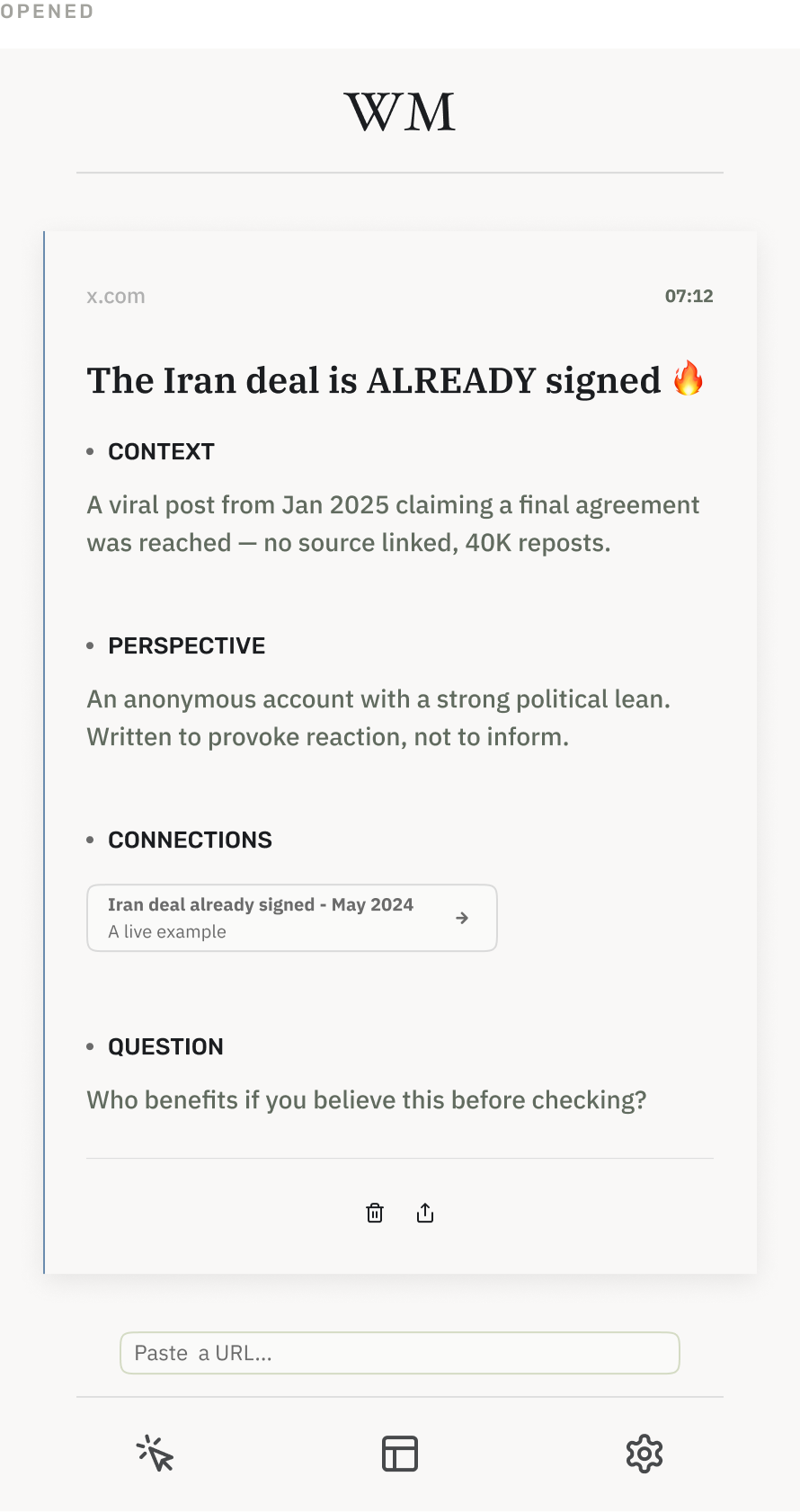
So the card doesn't judge. It gives you four layers, one at a time.
Context
What it is, when it was written.
%20Archive.svg)
Perspective
Who said it and why. No verdict.
%20Archive-1.svg)
Connections
Related archive items, each with a reason.
%20Archive-2.svg)
Question
One question to test source credibility.
%20Archive-3.svg)
Four layers at once is its own problem, so the card opens with Context and keeps the rest a step deeper. A card that opens with everything is a card nobody finishes.
What happens after you read it
Every card lands in the archive. Most of them shouldn't stay there.
- Short-term (24h). Anything you open lands here. Leave it alone and it's gone tomorrow.
- Long-term (Archive). Bookmark it and it stays. The archive holds only what you chose to keep.
No folders, no cleanup, nothing to decide later.
One card, many faces
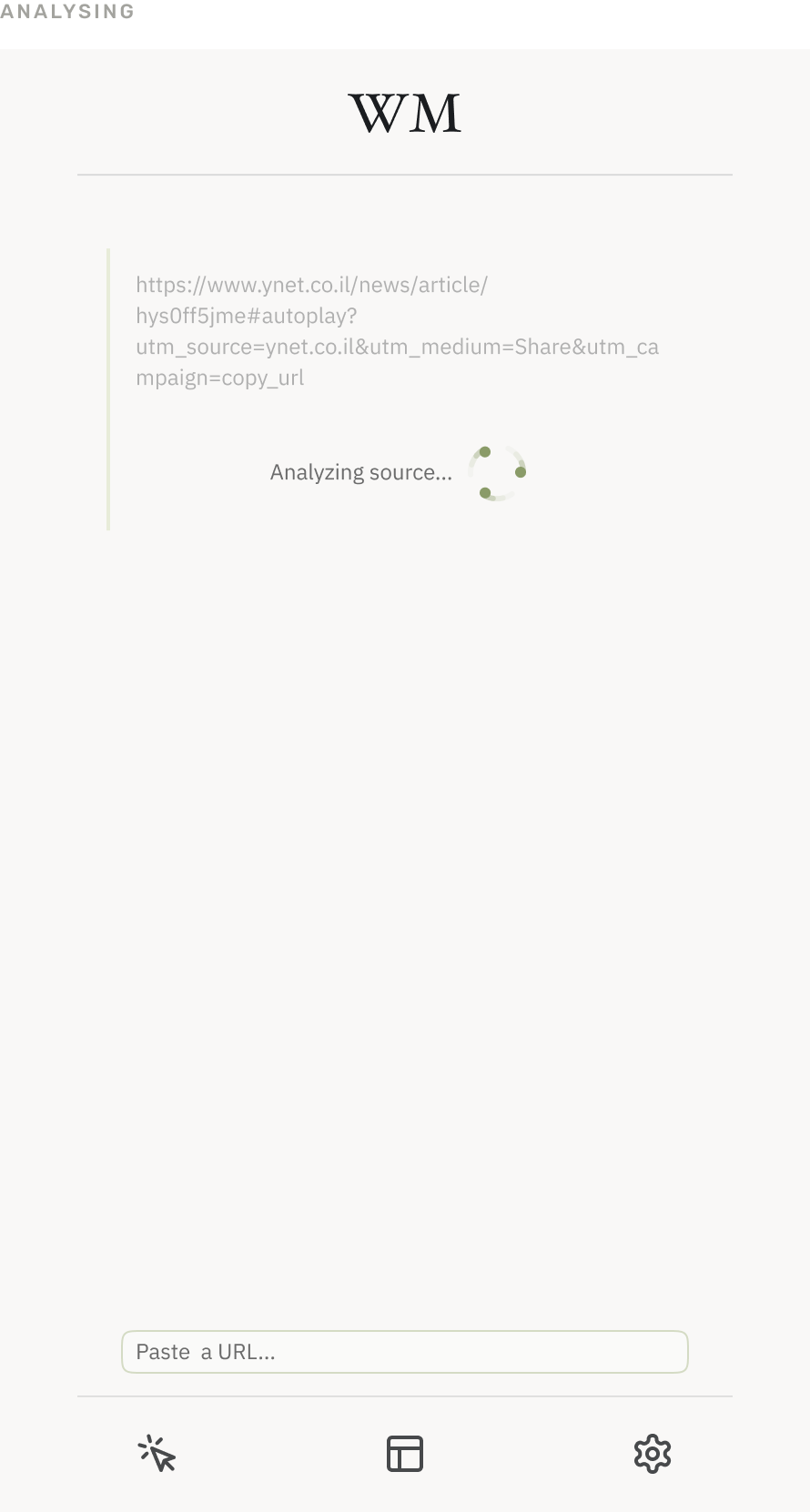
The same card does three jobs. It waits while the source is analysed, opens into the side panel when you read, and sits compact in the archive once you've kept it.
Eight variants became four. Each card had a twin for long titles and text, which the big side-panel card already covers. I cut the twins.

Calm is a system, not a mood
One restrained accent, for active states only. Category colour is a stripe or a dot, never a card background.
Colour-filled cards would be faster to sort through. They would also turn a reading tool into a dashboard - something you scan instead of read.


What the build changed
In Figma this was four dots. In the build they didn't hold up - at five pixels they read as decoration, not as a control you can press. Numbered steps with arrows replaced them: a real target, and a card that says how much is left.


The turn that mattered
Partway through, an honest doubt: it felt like a summarizer - useful, but replicable by any chat assistant. The sharper version of the idea:
The differentiator can't be "more AI." That ages out the moment anyone wires up an agent. The differentiator is UX and emergence - zero setup, zero maintenance, and nothing you have to decide in advance.
That produced auto-emergent Collections - the app notices a topic forming in your archive and quietly offers to group it.
Pull, not push. Oded is a technician, not a power user. He would never stand up an agent. That's the whole point.
Real limits I had to design around
Platform terms
Grounding with Google Search forbids caching results. An archive that accrues has to cache. Used an independent search API instead.
Data jurisdiction
Free-tier calls can train the model. For a tool people paste their own reading into, paid tier was a prerequisite, not an upgrade.
The real web
Server-side fetches get blocked as bot traffic. The extension reads the page already open in the browser instead.
Reflections & next steps
What I'd do differently
Broaden the research: Two interviews found a direction. They can't tell me whether that direction generalizes, and I built as if they could.
Match the platform to the person: This page says "meet people where they already read." Oded reads on his phone, in Telegram. I built a desktop Chrome extension. I wrote the principle down and then didn't follow it.
Treat legal and platform limits as inputs, not discoveries: The API terms, the data jurisdiction, and the bot-walls all landed after the concept was fixed. Each one could have been checked in an afternoon at the start.
Let’s build something great together.
I'm currently exploring new opportunities in product design and UX research.
My LinkedIn profile